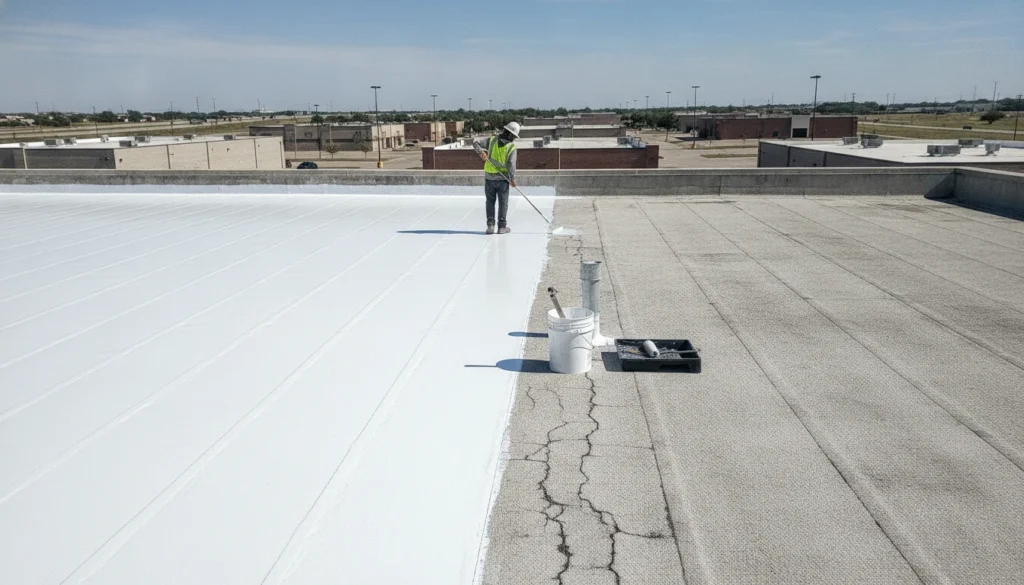
Restoration coatings: the middle path
A fluid-applied restoration system, silicone or acrylic over a sound substrate, can add years of service life, improve reflectivity, and cost a fraction of replacement. The honest qualifier: it only works over a dry, sound assembly, which is what the moisture survey establishes before anyone quotes anything.
How we decide whether your roof is a coating candidate
Coating is the best money in commercial roofing when it fits and wasted money when it doesn’t, so candidacy is where our process starts. The gate has three checks. Moisture: a survey across the field, with core samples where readings flag, because coating over wet insulation seals a failure in. Substrate condition: the membrane must be sound and adhered; aged is fine, failed is not. Drainage: where water ponds decides silicone versus acrylic chemistry. Roofs that pass get a coating quote with the evidence attached. Roofs that don’t get told why, with the repair-first or replacement path priced honestly. Roughly speaking, the best candidates are roofs in their late middle age, too good to tear off and too old to ignore.
What the service includes, end to end
Our coating projects run the full sequence: pre-work repairs (seams re-secured, flashings renewed, wet areas cut out and replaced dry), surface preparation with pressure washing and primers per the chemistry, fabric-reinforced detailing at every seam, penetration, and transition, then field coats applied to the manufacturer’s specified mil thickness and measured as we go, not assumed from coverage math. Manufacturer inspection follows on warrantied systems. The closeout hands you the warranty registration, the maintenance terms that keep it valid, and photo documentation of the whole sequence. The difference between this and “roof painting” is every step in this paragraph.
The budget conversation owners actually want
Coating’s pitch is arithmetic: a fraction of replacement cost, no tear-off or disposal, minimal operational disruption, and a 10-to-20-year warranted term with renewal recoats available. That means a sound roof can step from coating to recoat more or less indefinitely, deferring capital replacement a decade at a time. There’s often a tax wrinkle worth asking your accountant about: restoration frequently books as maintenance expense rather than capital improvement. Then add the reflectivity dividend. A white coating over a dark aged roof cuts surface temperatures dramatically and eases summer cooling loads, and the case usually argues itself wherever the candidacy gate says yes.
Timing a coating right
Coating rewards owners who move during the candidacy window: the years when a roof is aged but still sound. Wait too long and saturation or systemic seam failure closes the option, leaving only replacement; move too early and you’re restoring service life the roof already had. The window announces itself in an assessment: membrane oxidizing but intact, seams tired but sound, moisture readings clean or locally fixable. In DFW the calendar matters too. Coating chemistry wants dry weather and moderate temperatures for cure, which makes spring and fall the natural seasons and makes booking ahead of them the practical move. If your flat roof is past its first decade and has never been assessed for restoration, that assessment is the cheapest way to find out whether the best-value option in commercial roofing is still on your table.
The candidacy assessment is the no-risk first step: if your roof qualifies, you’ll see the coating case with evidence attached; if it doesn’t, you’ll know exactly why and what the honest alternative costs. Either answer beats wondering, and it beats discovering the window closed a year after it mattered.