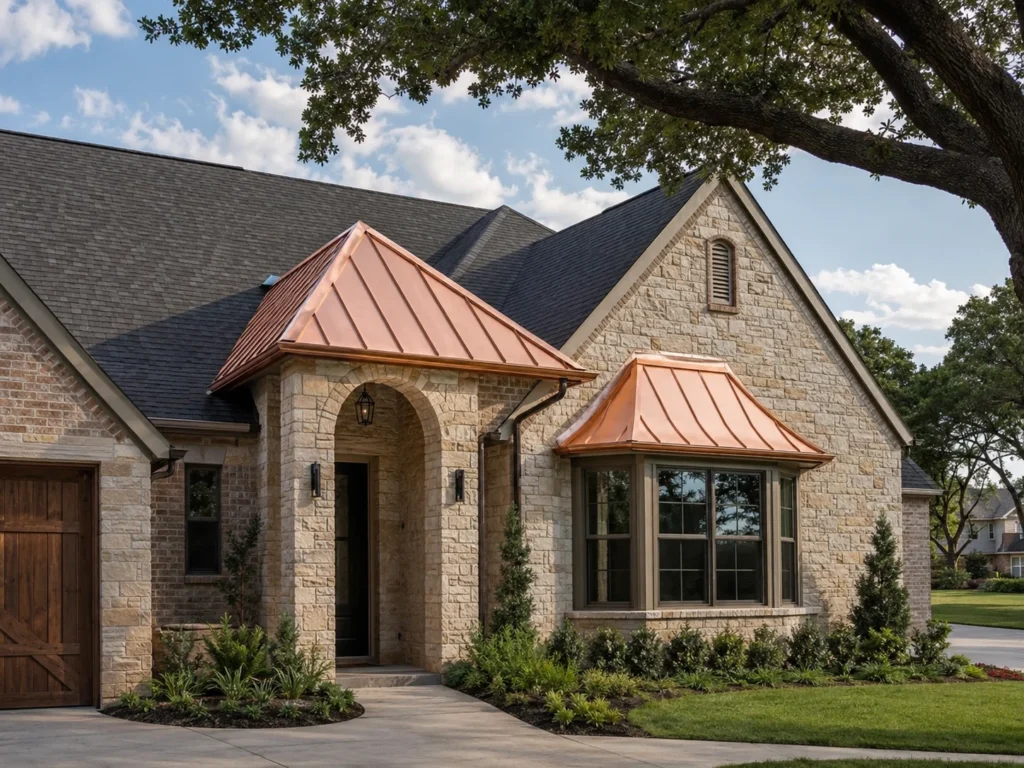
Copper is the roof measured in generations: a metal that doesn’t rust, doesn’t need coating, and doesn’t really have an end-of-life story anyone alive will witness. On DFW homes it appears mostly as accents (bay windows, porticos, turrets, chimney details) and occasionally as a full roof on properties built to deserve it. Either way, it’s the one roofing material that appreciates while it ages.
What makes copper different from every other metal
Steel and aluminum roofs depend on their coatings: galvanization, galvalume, paint systems. Their service life is largely the coating’s service life. Copper needs none of it. The metal weathers by building its own protective layer: bright penny-bronze at installation, deepening browns across the first years, and eventually the blue-green patina that takes decades in a dry climate like ours. That patina isn’t decay. It’s armor, a stable mineral layer that seals the metal beneath it. Century-old copper roofs are ordinary in the parts of the world that build with it, and the failure mode isn’t corrosion but mechanical: fatigue at poorly designed joints, which is a design problem rather than a material one.
Craft is the actual product
Copper installs as a craft trade, not a production one. Panels and details are formed, often on site, with soldered seams and folded joints in place of caulk and gaskets; flashings are shaped to the building rather than picked from a catalog. That has two consequences worth understanding before you buy. First, the labor is the cost: copper’s material premium is real, but the skilled-labor premium is the larger number, and it’s why copper work is quoted job by job rather than by the square. Second, the installer matters absolutely. Bad copper work fails at its joints within years, while good copper work is the most durable assembly in residential roofing. Portfolio and references aren’t formalities on a copper bid; they’re the specification.
The one detail Texas buyers must know: runoff staining
As copper weathers, rain carries trace amounts of it downstream, and copper-laden runoff stains light-colored masonry, stucco, and concrete a green-brown that’s effectively permanent. Good design handles this before it happens: gutters and downspouts routing copper runoff away from limestone and light brick, drip details that keep the wash off walls. On the DFW housing stock, which runs heavy on light masonry, this is the detail that separates copper contractors from contractors willing to install copper.
Thermal movement and fastening
Copper moves more with temperature than steel, and Texas gives it a wide range to move across. The traditional details exist precisely for this: cleats and folded locks that hold the metal while letting it float, expansion joints on long runs, and solder only where the geometry keeps joints stable. Rigid fastening is the classic amateur error. Screwed-tight copper buckles, fatigues, and tears at exactly the points meant to hold it.
Where copper makes sense in DFW
Full copper roofs belong to estate properties, historic restorations, and churches, buildings whose owners are buying the century, not the decade. Copper accents are the broader market: a copper bay-window roof or portico costs a fraction of a full roof, survives hail that shreds everything around it, and adds a visible signal of quality that real-estate photography loves. Hail dents copper as it dents all soft metal, but the patina’s self-healing chemistry means dents weather back into the roof’s texture rather than reading as damage. Insurance treats copper accents as part of the roof system; the cosmetic-exclusion conversation applies here as with all metals.
Maintenance, honestly
Nearly none, and that’s the point. No coating to renew, no fasteners to re-gasket on soldered work, no granules to shed. Inspections still earn their keep at the boundaries: where copper meets other materials, galvanic isolation must stay intact (copper in contact with steel or aluminum corrodes the lesser metal), and debris in copper gutters and valleys holds moisture against the patina where it sits. A copper detail installed right and left alone is the closest thing roofing has to permanent.