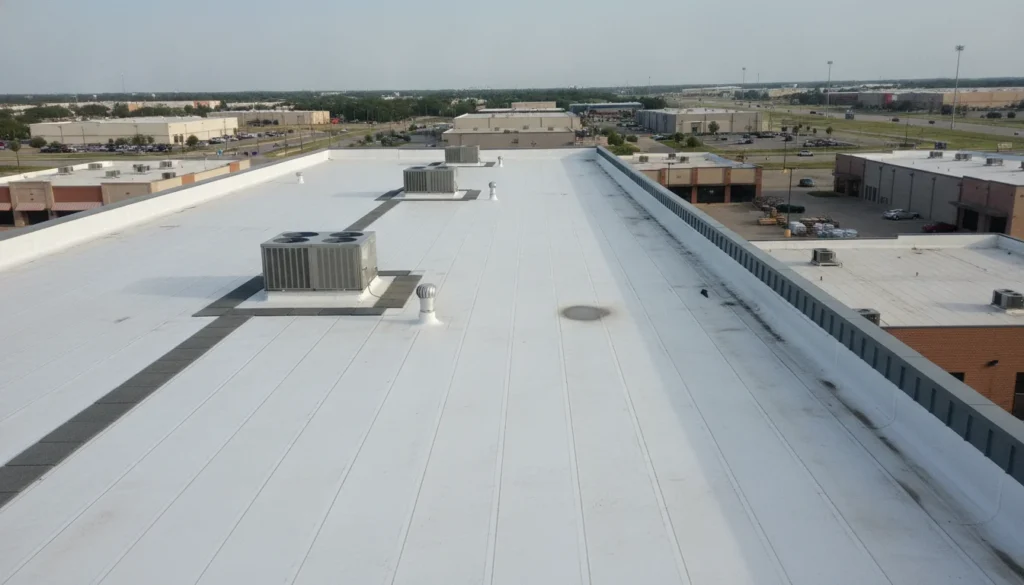
Commercial roofs in North Texas carry a different job description than residential ones: bigger fields, lower slopes, rooftop equipment, tenants underneath who cannot pause operations, and hail exposure that insurers price by the square foot. Getting the system right (TPO, EPDM, PVC, modified bitumen, coatings, or metal) is a budget decision that plays out over decades, not seasons.
Mastercraft Roofing handles commercial replacement, repair, restoration coatings, and preventive maintenance programs across the DFW metroplex, for property owners, facility managers, and management companies.
How we work with commercial properties
It starts with a documented condition assessment: core condition, seam integrity, drainage, penetrations, and remaining service life, delivered in writing. From there the honest conversation is repair, restore, or replace. Restoration coatings frequently buy a decade at a fraction of replacement cost when the substrate is still sound.
How commercial roofing actually differs from residential
Bigger is only part of it; commercial roofing is a different discipline. Commercial roofs are engineered assemblies: deck, insulation, cover board, membrane, each layer specified and each substitution consequential. The failure modes differ (seams, penetrations, ponding, and flashings rather than shingles), the diagnostics differ (moisture surveys and core samples rather than attic checks), and the economics differ: a commercial roof is a capital asset with restore-versus-replace decision points that reward evidence over instinct. Our commercial side runs replacement, repair, restoration coatings, and the preventive maintenance programs that keep all of it off the emergency calendar.
Who we work for
Building owners, property managers, facility directors, HOAs, and the tenants caught between them. The building types run the DFW inventory: office and retail, warehouse and light industrial, restaurants and medical, churches, schools, and self-storage, each with its own roof assembly conventions and its own operational constraints on how work gets scheduled. Multi-tenant properties get tenant-aware scheduling and communication; single-owner buildings get the restore-versus-replace analysis run against their actual hold horizon rather than a contractor’s preference.
The maintenance argument, made once
Most commercial roof spending in DFW is reactive (a leak, a tenant complaint, an adjuster’s deadline), and reactive is the most expensive way to own a roof. The alternative is boring and effective: documented twice-yearly inspections, drains kept clear, sealants renewed on schedule, small punctures patched while they’re small, and a photographic condition history that turns every future decision (claims, budgeting, restore-versus-replace, even building sale) into an evidence conversation. Owners who run maintenance programs spend less per year and replace roofs less often. That’s the entire pitch, and it’s true.
How commercial engagements usually start
Most of our commercial relationships begin one of three ways, and each has its own right first move. A leak or storm event starts with response: stop the water, document the cause, then quote the permanent fix with the evidence attached. A capital decision (an aging roof, a budget cycle, a purchase or sale) starts with the assessment: moisture survey, core samples where warranted, and a written condition report that makes the restore-versus-replace conversation an evidence conversation. And a management handoff, a new property manager or facility director inheriting a portfolio with no roof records, starts with baselines: a documented walk of every roof, ranked by condition and urgency, so the portfolio’s next three years of roofing spend can be planned instead of discovered. Whichever door you come through, the paperwork habits are the same: photos, written findings, itemized scopes, and a condition file that compounds in value the longer we work your building. Tell us which situation you’re in and we’ll start where it actually helps.
One more thing worth saying plainly: commercial roofing in this metroplex is a storm business whether anyone likes it or not, and the contractors worth hiring are the ones still answering their phones in the quiet years between events. We service what we install, we document what we service, and the office that quoted your roof is the office that answers about it five years later. In a market this visited by out-of-town storm crews, that is most of what “local” is worth.