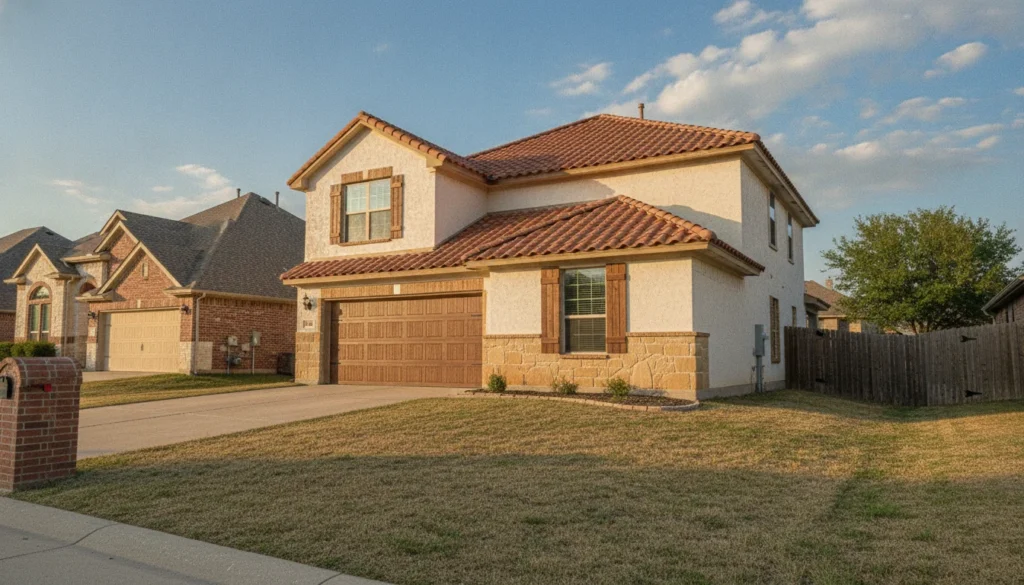
Clay and concrete tile define Mediterranean, Spanish, and certain custom architecture across DFW, and they give the homes built for them a roof that treats Texas sun as irrelevant. Tile’s virtues are longevity measured in generations and colorfastness no coating-dependent material matches. Its demands are equally real: serious weight, installation craft, and an honest understanding of what actually fails on a tile roof.
The real differences between clay and concrete
Clay tile is the original: kiln-fired terracotta whose color is the material itself, not a surface treatment, so a clay roof looks the same in year forty as year four. It weighs less than concrete, costs more, and is more brittle underfoot and under hail. Concrete tile is the pragmatic sibling: tougher against impact, meaningfully less expensive, cast in profiles that mimic barrel clay, slate, or shake. Its surface color mellows over decades rather than staying fixed; most owners find aged concrete tile handsome rather than faded. Both demand structure engineered for tile’s weight, the heaviest common residential roofing.
The secret every tile owner should know: the underlayment is the roof
Tile sheds most of the water; the underlayment beneath catches the rest and is the actual waterproof layer. Tiles can serve fifty-plus years; underlayment cannot. Most “failed tile roofs” in DFW are underlayment failures wearing a tile disguise: the tiles are fine, the membrane under them has aged out. The repair is a lift-and-relay: tiles come up, new premium underlayment goes down, the same tiles go back. It costs a fraction of full replacement and buys decades. Any tile roofer who quotes full replacement without discussing lift-and-relay is answering a question you didn’t ask.
Tile in hail country
Honest version: large hail can crack tile, and DFW storms are a genuine threat to any roof. Tile’s advantage is architectural: individual tiles replace cleanly, which is precisely the system’s design logic. A hail event that means full replacement for a shingle roof often means selective tile replacement plus inspection for a tile roof. Two practical notes: keep spare tiles from your original lot (color-matching discontinued profiles years later is a treasure hunt), and after any significant storm get the roof inspected by someone who knows how to walk tile without creating the damage they’re looking for.
Weight, structure, and the conversion question
Homes designed for tile carry it effortlessly. Homes framed for shingles usually cannot take tile without engineering, which is why “can I switch to tile?” starts with a structural evaluation, not a product brochure. Where framing allows it, conversion is real; where it doesn’t, stone-coated steel and synthetic systems deliver tile’s look at a fraction of its weight, no engineering required.
How we work on tile
Tile work is a craft discipline: proper walking technique, correct fastening and headlap for the profile, premium underlayment on every relay (the component that decides the next thirty years), flashing built for tile’s thickness, and ridge/hip details finished to the system spec. We repair, relay, and replace tile across DFW, and we tell you which of the three your roof actually needs.
Clay vs. concrete at a glance
| Clay tile | Concrete tile | |
|---|---|---|
| Color over time | Permanent (fired into the material) | Mellows gradually over decades |
| Weight | Heavy | Heavier, the heaviest common residential roof |
| Impact toughness | More brittle | Tougher against hail and foot traffic |
| Cost position | Higher | Meaningfully lower |
| Tile lifespan | 50+ years | 50+ years |
| Underlayment renewal | Decades before the tile, so plan a lift-and-relay | Same |
Buying a home with a tile roof? Inspect the right layer
Tile roofs fool standard home inspections: the tiles photograph beautifully at year thirty-five while the underlayment beneath them is running on borrowed time. If you’re buying a tile-roofed home anywhere in DFW, get a tile-specific roof inspection that evaluates the underlayment’s era and condition, the flashing details, and the fastening system. “The roof looks great” and “the roof needs a six-figure relay in three years” can both be true of the same roof on the same day. That inspection is cheap leverage before closing, and it’s the difference between negotiating the relay into the price and discovering it after you’ve moved in.
Flashing on tile: where the leaks actually start
Ask anyone who repairs tile for a living where tile roofs leak, and the answer is almost never “the tile.” It is the flashing (the metal transitions at chimneys, walls, valleys, and penetrations) plus the underlayment those flashings tie into. Tile’s thickness makes flashing a genuine craft: pan flashings must carry water over battens and under courses, wall flashings need proper counter-flashing rather than surface caulk, and valleys must be sized for the debris load a tile profile collects. When we inspect a leaking tile roof, we walk the flashing details first, because that is where the water is getting in. When we relay or repair, the flashing package is rebuilt in metal gauges and profiles matched to the tile system, not adapted from shingle-roof parts. It is slower and it is right, and on a roof designed to serve for half a century, the flashing should not be the ten-year component.
If you’re considering tile or already own it
Tile conversations split cleanly in two. Considering tile for a home built to carry it: the discussion is profile, clay versus concrete, and installer craft. Already own a tile roof: the discussion is almost always the underlayment’s age and whether a lift-and-relay belongs in your five-year plan. Either way, the free inspection produces written findings with photos. On tile specifically, that means an inspection by people who know how to walk it without cracking what they came to assess.