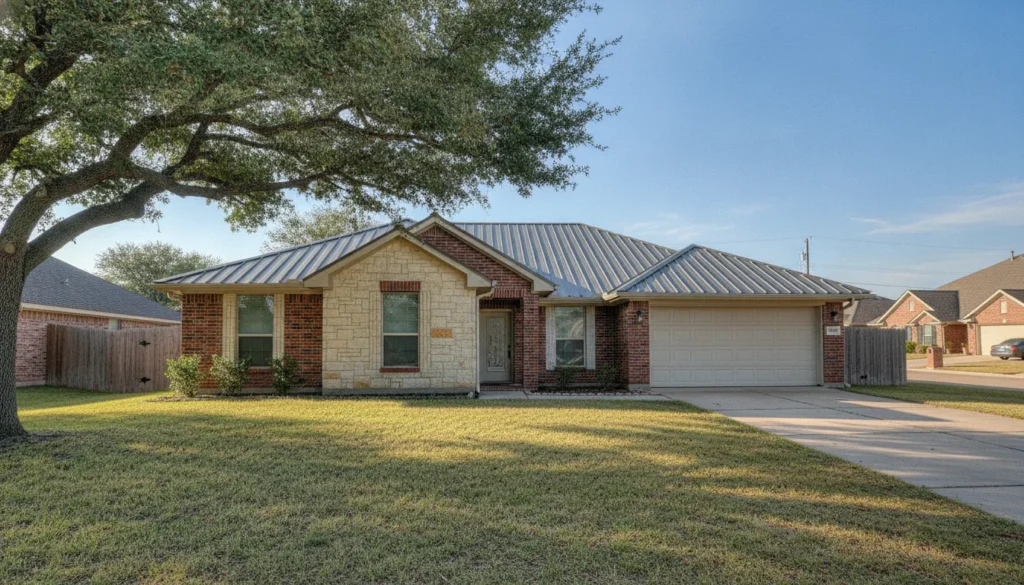
Metal roofing trades a higher day-one cost for decades of additional service life, wind performance shingles can’t match, and a hail story that matters enormously in North Texas: metal dents where shingles die. For DFW homeowners planning to stay put, or building something they intend to hand down, metal is usually the strongest per-year value in roofing.
The metal family, sorted honestly
Standing seam is the premium residential system: concealed fasteners under raised vertical seams, panels that float on clips as temperatures swing, nothing exposed to back out or gasket-fail. It costs the most and asks the least maintenance. R-panel is the Texas workhorse: exposed-fastener panels that deliver metal durability at a working price, with a fastener-check maintenance rhythm as the trade. Corrugated is the classic wavy profile, economical and deliberately rustic. Stone-coated steel wraps metal’s performance in a tile or shake appearance, often the answer where HOAs frown on bare panels. Copper is the generational material for accents and estates. Most of these are galvalume-coated steel at heart; aluminum earns its premium mainly where salt air lives, which DFW is not.
The hail conversation, without the sales gloss
Hail is why North Texans call us about metal, so here is the straight version. Significant hail can cosmetically dent metal panels. That is real, and softer metals like aluminum and copper dent more readily than steel. What hail rarely does to quality metal is breach it: the weather seal typically survives impacts that would bruise, crack, or strip a shingle roof into a total loss. One practical wrinkle worth knowing before you buy: some insurance policies handle “cosmetic damage” to metal roofs differently than functional damage. Ask your carrier how your policy treats it, and we’ll document either way.
Heat, noise, and the other myths
Two questions arrive with every metal quote. “Is it loud in rain?” Over a solid deck with underlayment, which is how residential metal is actually installed, the difference from shingles is minor; the barn-roof drumming people remember comes from panels over open framing. “Does it make the house hot?” The opposite: metal reflects solar radiation that asphalt absorbs, and light-colored or reflective-coated panels routinely reduce summer cooling loads. In a Texas August, that’s a feature you feel.
What drives metal roofing cost
Five levers, no dollar figures, and an honest quote itemizes them. System type: standing seam costs meaningfully more than exposed-fastener profiles. Panel gauge and coating: thicker steel and better paint systems (PVDF vs. polyester) cost and last more. Roof complexity: hips, valleys, dormers, and penetrations multiply trim work, which is where metal labor lives. Tear-off: what’s coming off and how many layers. Trim and flashing detail: the difference between a metal roof that lasts fifty years and one that leaks at year eight is almost always in the details, not the panels.
How we install metal
Solid decking, high-temperature synthetic underlayment, and the manufacturer’s engineered trim package, not shop-bent guesswork at the critical planes. Panels cut and seamed to the roof’s geometry, clip spacing and fastener torque to spec, and every penetration flashed with components designed for metal’s thermal movement. Metal rewards precision and punishes shortcuts more than any other system we install.
The metal systems side by side
| System | Fasteners | Maintenance rhythm | Look | Price position |
|---|---|---|---|---|
| Standing seam | Concealed, on clips | Minimal | Clean vertical lines, modern or classic | Premium |
| R-panel / PBR | Exposed, through face | Fastener checks every few years | Working Texas ranch/shop | Working price |
| Corrugated | Exposed | Fastener checks | Deliberately rustic wave | Most economical |
| Stone-coated steel | Concealed interlock | Low | Reads as tile or shake | Upper-middle |
| Copper | Soldered/seamed craft | Essentially none | Living patina, generational | Top of market |
Gauge and coatings: the spec lines that matter
Two spec-sheet lines separate metal roofs that look good at year thirty from ones that chalk and fade by year ten. Gauge is steel thickness, and lower numbers are thicker. Thicker panels resist hail denting and foot-traffic damage better, and the difference between bargain-gauge and quality-gauge panels is invisible on day one and obvious after the first big storm. Coating chemistry is the paint system: PVDF (often sold under the Kynar name) holds color and gloss dramatically longer under Texas UV than economy polyester coatings. When two metal quotes look far apart on price, gauge and coating are usually where the difference lives. Ask both bidders for the two numbers and the quotes tend to explain themselves.
What goes under the metal matters as much as the metal
A metal panel can outlive two underlayments, which is exactly why the underlayment specification deserves attention at purchase time. Metal roofs run hot: Texas panel temperatures demand high-temperature-rated synthetic underlayment, because standard felt and economy synthetics degrade under sustained heat and turn a fifty-year panel into a shield over a failing membrane. Ventilation carries the same logic. Metal reflects solar gain, but the attic beneath still needs balanced intake and exhaust. Without it, condensation can form on the panel underside in winter and cook the deck in summer. When we quote metal, the underlayment product and the ventilation math are line items you can read, because they are the parts of a metal roof that actually determine whether the panel’s lifespan gets used. A premium panel over a cut-rate assembly is a bad roof with a good hat.
If you’re thinking about metal, start here
The useful first step is not a quote; it’s a look at your roof’s geometry and your time horizon. Simple gable roofs make metal shine on price; complex roofs with many hips and dormers move more of the budget into trim labor. And metal’s economics reward owners who stay: the longer you’ll hold the home, the harder metal’s per-year math beats asphalt. Tell us the address and how long you plan to be there, and we’ll tell you honestly whether metal makes sense, including when the answer is that a Class 4 shingle serves you better.