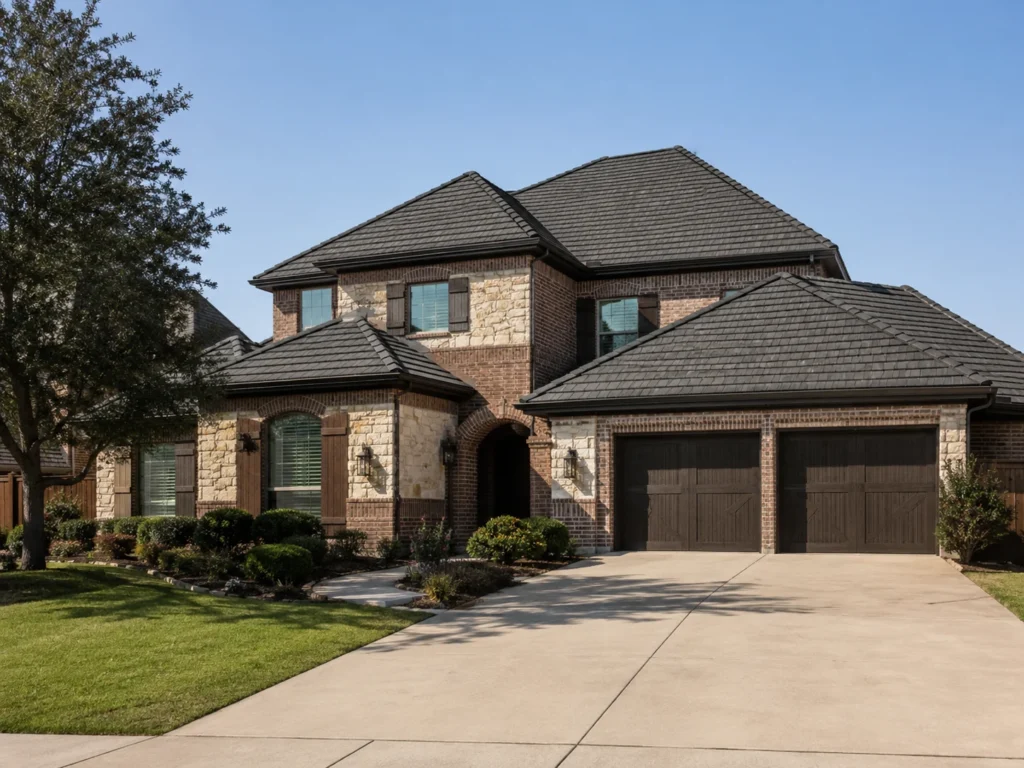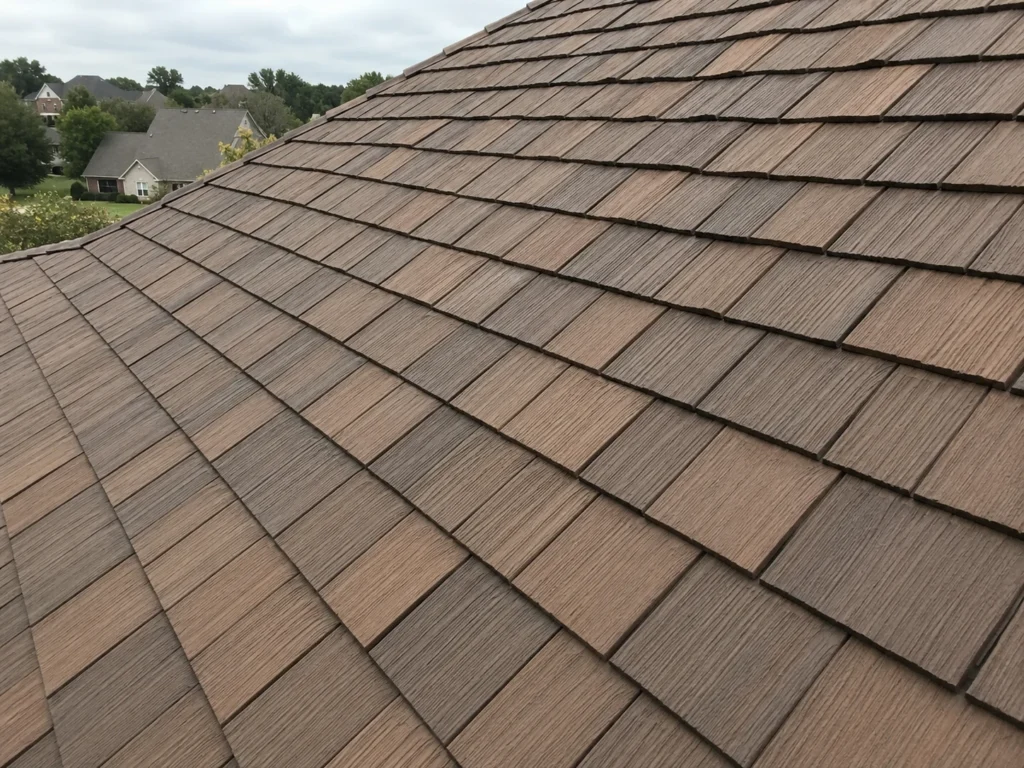
Synthetic slate and shake systems exist because two of roofing’s most beautiful materials come with disqualifying fine print: natural slate’s weight rules out most homes ever framed, and cedar’s maintenance calendar rules out most owners’ patience. Engineered polymer tiles solve both, and in DFW they carry a third argument the natural materials can’t match: Class 4 impact ratings across most quality product lines.
What these products actually are
Quality synthetics are engineered polymer (and polymer-composite) tiles cast from molds of the real thing, meaning actual slates and actual hand-split shakes, with UV stabilizers and impact modifiers through the material, not coated on. The result installs like a conventional roof: standard decking, standard techniques, ordinary structural loads. No engineer, no lift-and-relay economics, no treatment schedule. One clarity note, because Texas vocabulary invites confusion: composite/synthetic roofing is not “composition” roofing. Composition is the local slang for asphalt shingles. Different material, different price class, different page.
The two families
Synthetic slate delivers the estate profile of quarried slate at roughly the weight of architectural shingles, which is the whole reason the category exists. Homes that could never carry stone get the look without a single engineering calculation. Synthetic shake reproduces cedar’s texture without cedar’s calendar: no treatment cycles, no moss management, strong fire ratings without pressure treatment, and hail behavior wood can’t offer.
The DFW case: hail
Most quality synthetic lines carry Class 4 impact ratings; the polymer flexes where slate cracks and cedar splits. In a metroplex where hail is the leading cause of roof death, that single property changes the ownership math: fewer storm losses over the roof’s life, and the same insurance-discount conversation that applies to Class 4 shingles (ask your carrier, since discounts vary by policy). It is the strongest practical argument for the category, ahead of even the aesthetics.
The honest trade-offs
Three, stated plainly. Up-close authenticity: from the street, good synthetics read convincingly; in hand, the uniformity shows. Molds repeat; real slate and real cedar never do. Track record: natural slate has centuries of history and cedar has generations, while synthetics have decades. Quality lines back that gap with long warranties, but a warranty is a promise, not a history. Cost position: synthetics sit well above asphalt. This is a premium category that competes with the materials it imitates, not with shingles.
How we install synthetics
By the manufacturer’s book, which is the entire game with engineered products: specified fasteners and nailing zones, correct exposure and stagger, the system’s own starter, hip, and ridge components, and underlayment matched to the spec. Warranty coverage on these lines is conditioned on installation compliance. Cut corners on a premium synthetic roof and you have paid for certainty while installing doubt.
Synthetic vs. the naturals it imitates
| Synthetic slate | Natural slate | Synthetic shake | Natural cedar | |
|---|---|---|---|---|
| Weight | Like architectural shingles | Extreme (engineering required) | Light | Moderate |
| DFW hail | Class 4 on quality lines | Cracks under impact | Class 4 on quality lines | Splits and bruises |
| Maintenance | Minimal | Specialist repairs | Minimal | Real calendar |
| Fire | Rated as manufactured | Inherently fireproof | Rated as manufactured | Needs pressure treatment |
| Track record | Decades | Centuries | Decades | Generations |
| Up close | Uniform | Each piece unique | Uniform | Each shake unique |
How to read a synthetic roofing warranty
Synthetic warranties are long (that’s part of the sales pitch), so read for the terms that actually bite. Prorated vs. non-prorated: many long warranties taper coverage sharply after an initial period; the headline number and the year-twenty payout can be very different documents. Transferability: some coverage follows the home, some evaporates at sale, and some transfers once with paperwork. It matters for resale value. Installation conditions: manufacturer coverage on engineered products is conditioned on spec-compliant installation, which is why we install to the book and document it. The photos protect your warranty, not just our reputation. And remember the rule that applies to every roofing warranty in Texas: weather damage is excluded. Hail is an insurance conversation on every material; the synthetic advantage is that Class 4 polymer gives hail much less to work with.
Where synthetics fit in the DFW housing stock
The synthetic category earns its keep on three kinds of North Texas homes. First, architecture that calls for slate or shake (Tudor, French country, mountain-lodge customs) on framing that was never engineered for stone and owners who never volunteered for wood maintenance. Second, hail-weary owners of premium homes replacing a natural material for the second or third time and ready for Class 4 polymer to end the cycle. Third, HOA-governed neighborhoods where architectural standards demand a slate or shake profile but say nothing about what it’s made of; quality synthetics routinely clear design review where the boards would reject anything reading as ordinary shingles. Where synthetics fit worst is equally worth saying: on modest homes where the budget conversation belongs with architectural or Class 4 asphalt instead, a synthetic quote is answering a question nobody asked. We’ll tell you which of those situations your home is in. The honest fit conversation costs nothing and prevents the expensive kind of regret.
Seeing synthetics in person
Product photography flatters every roofing material, so synthetics deserve judging in the hand and on a roof. Manufacturers supply full-size samples, and DFW has enough installed synthetic fields that we can usually point you at a street-visible example of the profile you’re considering. Ask when you request your estimate; ten minutes with a sample answers the authenticity question better than any web page, including this one.
One practical insurance-file tip that applies across the category: when we install a Class 4 synthetic system, we provide the product’s impact-rating certification for your records. Send it to your insurance agent the week the roof goes on, because carriers apply wind/hail discounts prospectively, not retroactively, and the paperwork takes minutes while the discount runs for the life of the policy. It is the cheapest money a premium roof ever earns you, and it is routinely forgotten.